The Grounds
Architecture and landscape
The Site
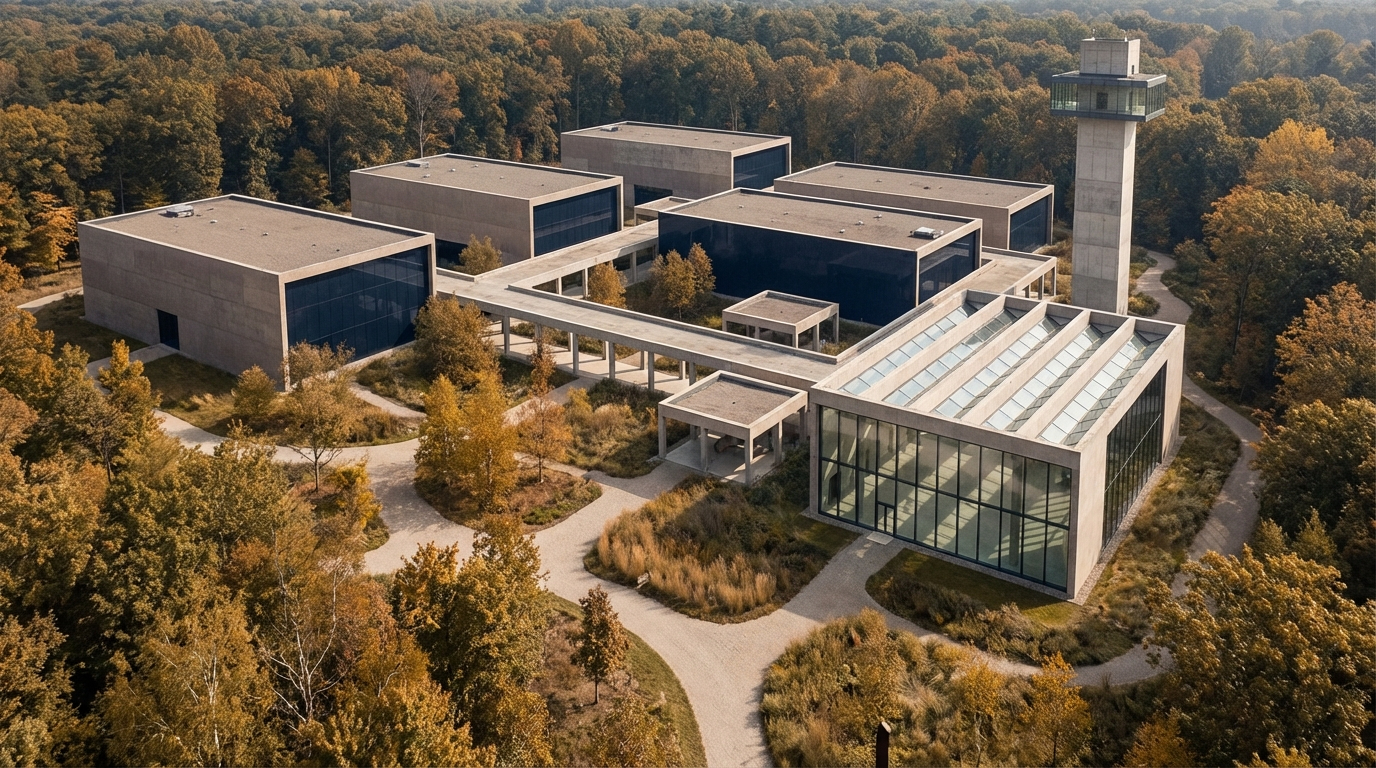
The park occupies forty-two acres in a temperate coastal region, at an elevation of approximately 120 meters above sea level. The terrain is mostly flat with a gentle slope toward the north. Native coastal vegetation includes sea lavender, yarrow, and coastal sage. The site has unobstructed views to the horizon in all directions. The landscape is maintained in its natural state except where paths and pavilions have been constructed.
The Central Pavilion
A single-story structure of concrete and glass with a flat roof and deep overhangs extending eight feet beyond the perimeter walls. The east wing houses Galleries One and Two. The west wing houses Galleries Four and Five. The north tower contains Gallery Three, the Observatory, with an oculus window six feet in diameter at the apex of a conical interior space. The lower level contains Gallery Five, the Thinking Machine exhibit. All interior walls are white painted concrete. The pavilion's glazing is cleaned quarterly.
The South Pavilion
Added in a second construction phase, connected to the central pavilion by a covered concrete walkway. Houses Galleries Seven and Eight, "The Archive" and "Worlds of Tomorrow." Single-story concrete and glass construction, matching the design vocabulary of the central pavilion. The south wall is entirely glazed, providing views to the sculpture garden. A smaller annex extends from the western end of the south pavilion, connected by a short corridor. Gallery Nine, the Studio, occupies this space.
Gallery Six
Located on the upper level of the central pavilion. Reached by an interior staircase with steel railings. Houses rotating exhibitions related to generation ships and large-scale speculative spacecraft. The space has north-facing skylights providing indirect illumination.
The Sculpture Garden
Occupies the space between the central and south pavilions, approximately 150 feet east to west and 200 feet north to south. Three full-scale spacecraft reproductions in weathering steel and painted aluminum:
- A Verne-style projectile, four meters tall, riveted iron finish with a copper accent band at the midline, mounted on a concrete pad
- A flying saucer, eight meters in diameter, polished aluminum, mounted on a concrete pedestal at a five-degree tilt
- A generation ship bow section, twelve meters long, oxidized steel, positioned horizontally on steel supports
The sculptures are inspected annually for corrosion and weathering.
Walking Paths and Vegetation
A network of gravel walking paths, four to six feet in width, well-graded and compacted. Paths run from the entrance pavilion through the sculpture garden to the observation platform and beyond. Native coastal plantings flank the paths on both sides. Paths are re-graded seasonally, typically in spring and fall, to maintain proper drainage and surface condition.
The Observation Platform
Located at the highest point of the property, approximately 120 meters above sea level. Concrete and steel construction, open structure with roof shelter and steel railings. Recently restored, with structural supports and railings replaced. Provides unobstructed views to the north, east, and south. Exposed to prevailing coastal winds.
Maintenance
The grounds are maintained year-round. Pavilion glazing is cleaned quarterly. Walking paths are re-graded seasonally and inspected quarterly for settling and erosion. The sculpture garden pieces are inspected annually for corrosion and structural integrity. Native vegetation is maintained to preserve existing character.