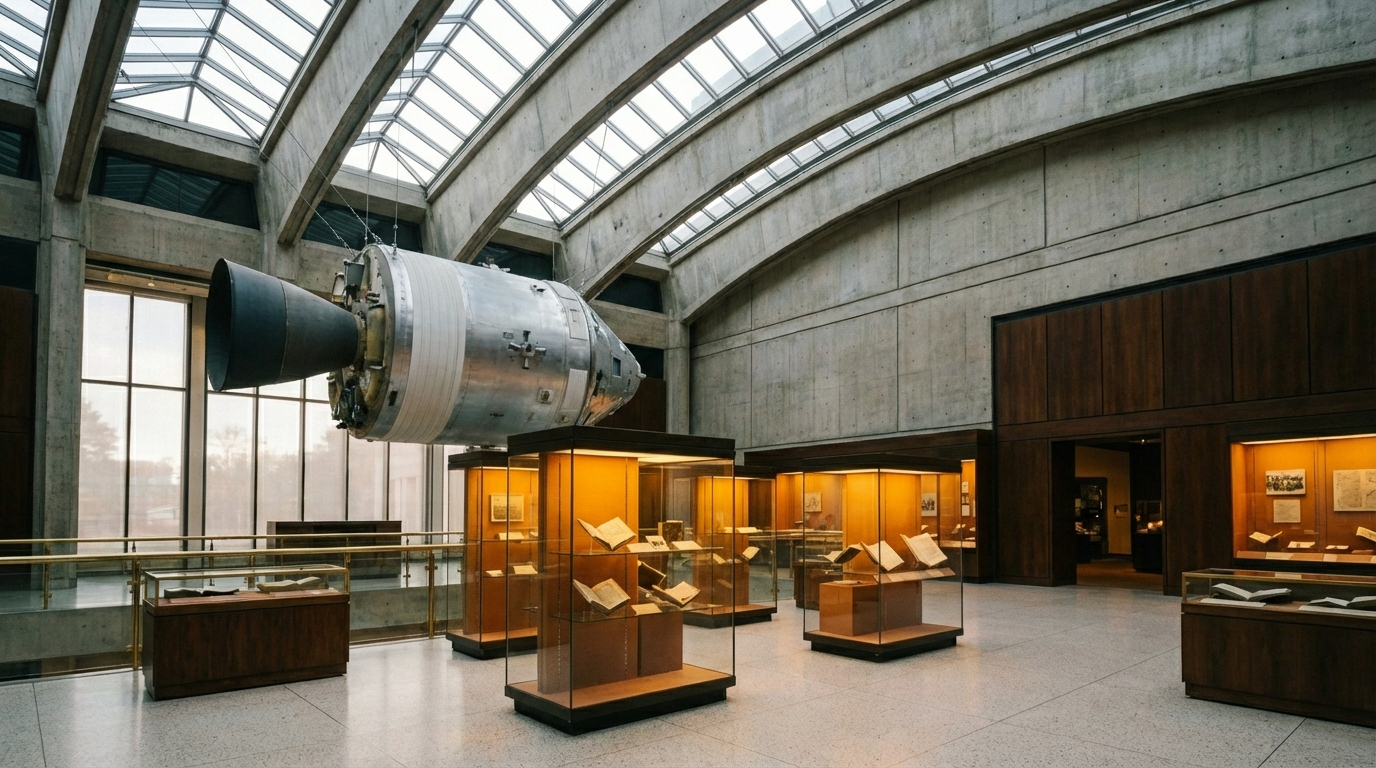
A first edition of Verne's From the Earth to the Moon, published in 1865, sits in a glass case near the gallery entrance. The book is open to the page where Verne calculates the velocity required to escape Earth's gravity. The calculation is close. Beside the book, mounted on a steel cradle approximately one and a half meters above the floor, is a full-scale replica of the Apollo Command Module in the configuration used on Apollo 11. The hatch is open. Inside, three hundred and twelve switches and circuit breakers line the instrument panel. The couches are set to launch position. Visitors may step up to the hatch but not enter; the interior is visible through the opening and through a porthole cut into the thermal shielding on the starboard side.
Between the Verne and the module, a century passed. The gallery makes no argument about which led to which.
The Mercury and Gemini Cases
The east wall pairs flight hardware with the novels that preceded it. A reproduction of John Glenn's Mercury pressure suit — silver fabric, aluminum fittings, the helmet visor tinted gold — stands in a freestanding case at center. The suit is pressurized to maintain its shape. To its left, a first edition of Heinlein's The Man Who Sold the Moon, published in 1950, twelve years before Glenn's flight. The novel's protagonist eats freeze-dried rations on a lunar voyage; beside the Heinlein, a freeze-dried beef stew pouch from the Mercury program, sealed since 1962, recovered from a storage facility in Cape Canaveral.
The lower cases along this wall contain flight logs, communication transcripts, and navigation charts. A chart from Gemini 7 shows hand-plotted rendezvous calculations — pencil on vellum, the work precise, the margins clean. Next to it, Clarke's A Fall of Moondust, a first printing from 1961 with a cracked spine and a previous owner's name in blue ink on the flyleaf. The name is illegible. The book describes a lunar surface vehicle; the Gemini chart describes the orbital mechanics that would eventually get hardware to the same surface.
Apollo Guidance Computer
A working reproduction of the AGC — the computer that guided the Lunar Module to the surface of the Moon. The unit weighs approximately thirty kilograms and operates with seventy-four kilobytes of memory. Visitors can enter commands using the DSKY interface; the display responds with the same verb-noun syntax used during the Apollo 11 descent. The original software was hand-woven into rope memory by workers at the Raytheon plant in Waltham, Massachusetts. The reproduction was built from declassified schematics recovered from a university archive.
The Apollo Gallery
The central bay is devoted to Apollo. A cross-section model of the Saturn V, cut lengthwise at one-twentieth scale, runs along the south wall — eighteen feet of fuel tanks, engine bells, instrument rings, and the command module at the top. Each stage is labeled with thrust figures and burn durations. In the glass case beside the third-stage cutaway, Clarke's 2001: A Space Odyssey, first edition, 1968 — the same year the Saturn V first carried astronauts. The book's dust jacket is intact. A small water stain marks the lower right corner.
A sample case near the south window holds three fragments of lunar basalt collected by the Apollo 17 crew in December 1972. The samples are 3.7 billion years old. They are dark, fine-grained, and heavier than they look. Beside them, Bradbury's The Martian Chronicles, first edition, 1950, Doubleday. Some foxing to the endpapers. Bradbury described the texture of alien soil two decades before anyone held a piece of it.
Voyager and the Golden Record
The gallery's west alcove is quieter and more dimly lit. A full-scale model of the Voyager spacecraft hangs from the ceiling at a slight angle, the high-gain antenna dish pointed toward the entrance. The magnetometer boom extends three feet past the display boundary; a floor marking indicates the clearance.
Below the model, a reproduction of the Golden Record is displayed in a wall-mounted case — the aluminum cover with its etched pulsar map, and the record itself, copper-gold, twelve inches in diameter. A listening station with two sets of headphones plays selections: Bach's Brandenburg Concerto No. 2, greetings in fifty-five languages, the sound of wind and rain and surf, a mother's first words to a newborn child. The record plays on a loop. The headphones are cleaned daily.
On the shelf below the listening station, a copy of Sagan's Murmurs of Earth, first edition, 1978, describing the creation of the record. The book was found with the record's production documentation in a filing cabinet in Ithaca, New York. Both were in good condition.
Collection Notes
- Verne, From the Earth to the Moon First edition, 1865. Hetzel, Paris. Open to velocity calculation. Recovered from a private library, condition fair. Binding restored.
- Heinlein, The Man Who Sold the Moon First edition, 1950. Shasta Publishers. Previous owner's annotations in pencil, margins.
- Clarke, A Fall of Moondust First printing, 1961. Owner's name in blue ink, flyleaf, illegible. Spine cracked at page 140.
- Clarke, 2001: A Space Odyssey First edition, 1968. New American Library. Dust jacket intact. Water stain, lower right corner.
- Bradbury, The Martian Chronicles First edition, 1950. Doubleday. Foxing to endpapers. Recovered from a bookshop in Los Angeles, stock unsold.
- Sagan, Murmurs of Earth First edition, 1978. Random House. Found with Voyager production files, Ithaca, New York.
- Mercury-Atlas 6 flight log Reproduction, 1962. Original held at a national collection, Washington, at time of closure.
- Gemini 7 navigation chart Original document. Pencil on vellum. Recovered from NASA Langley storage facility.
- Apollo 11 mission patches (3) Crew-issue, embroidered. Recovered from a private collection, Houston.
- Lunar basalt samples Apollo 17, Station 5. Transferred from the Lunar Sample Laboratory prior to facility decommission.
- Freeze-dried beef stew pouch Mercury program, 1962. Sealed. Recovered from Cape Canaveral storage.
- Voyager Golden Record reproduction Copper-gold anodized aluminum. Playable. Built from NASA specification documents.
- Apollo Guidance Computer reproduction Built from declassified schematics. Thirty kilograms. Rope memory. DSKY interface operational.