The gallery opens with the SETI exhibit occupying the north wall. A reproduction radio dish model stands on a pedestal approximately one meter above the floor — the dish is three feet in diameter, aluminum-coated, the feed antenna mounted at its focal point. The model is built to demonstrate how radio telescopes collect and focus weak signals from space. Beside the model, a headphone station allows visitors to hear actual signal recordings from the Hat Creek array — the hum and crackle of cosmic radio noise, punctuated by brief moments of artificial-seeming regularity. A placard explains that this is not alien contact but a demonstration of what the radio noise of the universe sounds like. Below, a speaker broadcasts at low volume a continuous loop of these recordings.
The west wall holds a large brass-mounted display of the Drake Equation. Each variable appears on a separate sliding scale — the rate of star formation, the fraction of stars with planets, the fraction where life emerges, the fraction where intelligence develops, the fraction that achieves technology, the average lifespan of a technological civilization. Visitors can adjust each scale. As they move the sliders, a digital readout below the equation updates in real time, showing the calculated number of communicative civilizations in the Milky Way. The scales allow for both optimistic and pessimistic estimates. Set everything high and the galaxy fills with millions of potential civilizations. Set everything low and the number collapses to near one. A note explains that even scientists disagree on what the correct values should be.
The War of the Worlds Listening Station
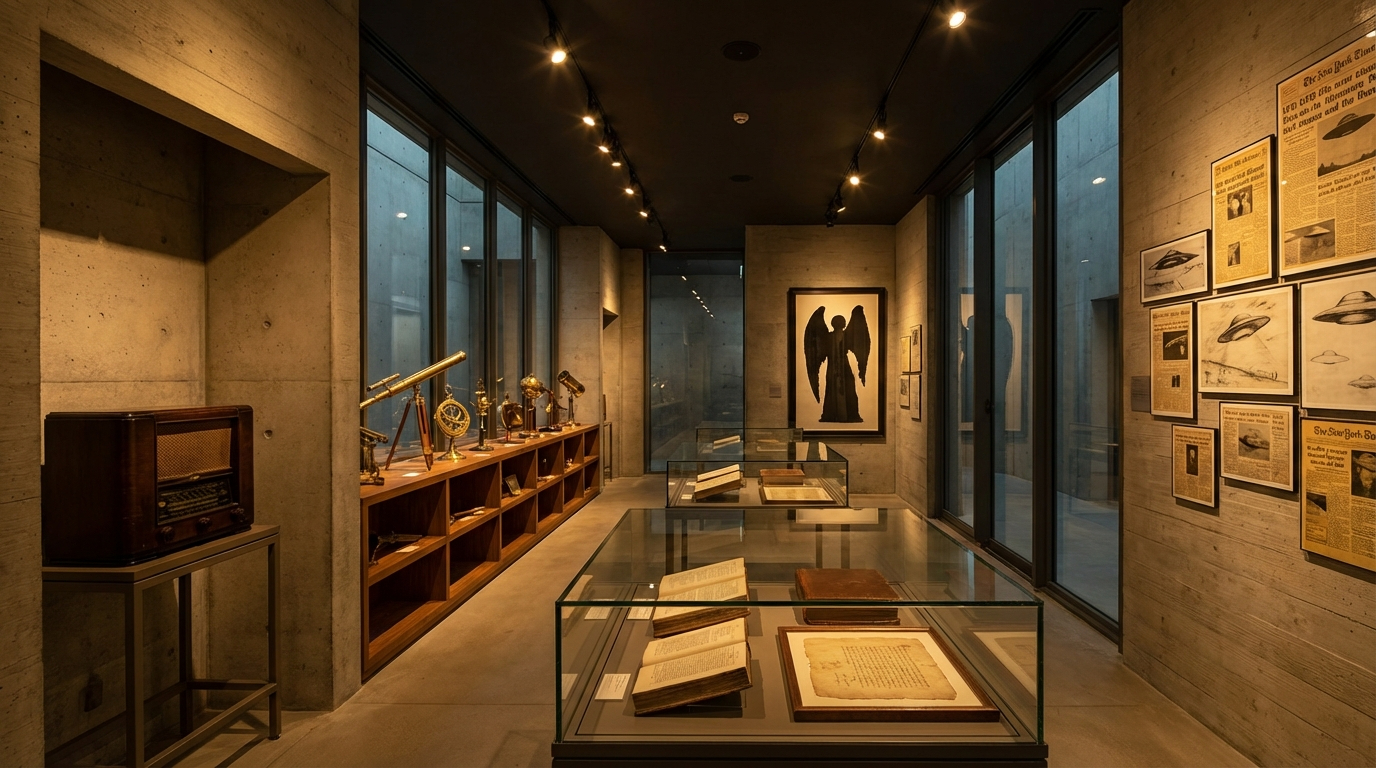
In the south alcove, a period Philco radio sits on a stand, its wooden cabinet intact, its dial and controls original. The radio is functional. It broadcasts excerpts from the Orson Welles 1938 radio dramatization of H.G. Wells's The War of the Worlds — the opening moments where the broadcast breaks into news coverage of a Martian landing in New Jersey. The panic in the voices is audible. Emergency bulletins. Reports of military action. The broadcast was mistaken by many listeners for actual news. A placard describes the panic that resulted — thousands of phone calls to police and newspapers, families packing cars to flee the supposed invasion. A book case nearby holds a first edition of Wells's novel, opened to a passage describing the Martian machines. Beside it, news clippings from the 1938 broadcast panic, under glass.
Flying Saucers and Sightings
The east wall displays Kenneth Arnold's 1947 sighting sketches — hand-drawn pictures of the crescent-shaped objects he reported seeing near Mount Rainier. The sketches are reproductions, meticulous in their rendering. The original newspaper clippings are mounted beside them, still showing the characteristic fonts and layouts of 1947 journalism. A large case holds additional UFO sightings from the 1950s and 1960s — photographs, witness testimonies, official Air Force documents. Many sightings are mundane: misidentified aircraft, weather balloons, stars seen through atmospheric distortion. A few resist explanation. The case contains no judgment, only documentation.
Aliens in Literature
The central corridor displays alien species as described in novels. Each installation pairs the book with a reconstruction or description of the species.
The first case holds Wells's The War of the Worlds, first edition, 1898. The novel is open to the passage describing the arrival of the Martian tripod machines. A mounted placard excerpts the physical description of the Martians themselves — beings with tentacles, distributed sensory organs, described with anatomical precision. This is the only encounter among these cases where the alien physiology is fully articulated and visible to the observer.
The second case contains Clarke's Childhood's End, first edition, 1953. The Overlords arrive in massive ships above the great cities of Earth. They speak through human translators. They remain unseen for decades, speaking only from above, withheld from visual contact. When finally revealed, their description appears in the text as a shock: they resemble devils as imagined by medieval humans — horned, winged, dark. The book is open to the moment of their appearance. A reconstruction, built from Clarke's description, hangs in a nearby frame: the silhouette of a being upright, wings folded, horn profile sharp against a dark background. The gallery offers the novel and the description but does not resolve the question of whether the Overlords' appearance shaped human mythology or human mythology shaped how humans perceived them.
The third case displays Lem's Solaris, first edition Polish, 1961. A brief placard describes the planet Solaris and the ocean-intelligence that inhabits it. The ocean is a conscious entity, responsive and sentient, but its nature resists categorization. It does not communicate through language. It reacts to human presence in ways that mimic human emotions but may not originate from emotion at all. The ocean is described as incommensurable — a form of consciousness so alien that dialogue may be impossible. This case contains only the book and the placard; no reconstruction attempts to visualize the intelligence of Solaris. The incomprehensibility is the point.
The fourth case holds a first edition of Strugatsky and Strugatsky's Roadside Picnic, English translation 1978. The novel describes a zone on Earth where alien visitors have left behind objects of incomprehensible purpose — devices and artifacts that serve no obvious function, that seem designed by a logic entirely foreign to human engineering. The aliens never appear. Their visitation is known only through the artifacts they left, scattered like refuse at a picnic ground. The case displays the book alongside diagrams of the fictional artifacts — spheres, crystalline forms, mechanisms that suggest function without revealing it. The plaque notes that the Strugatskys were describing first contact not as dialogue but as archaeology, first contact as the discovery of things left behind by beings who remain absent.
The fifth case contains Le Guin's The Left Hand of Darkness, first edition, 1969. The Gethenians are humanoid but alien in their biology. They are ambisexual, capable of reproduction only during a fertile period. This fact of their physiology shapes their culture, their psychology, their approach to conflict and sexuality and politics. The book is open to passages describing Gethenian appearance and behavior. A placard notes that the Gethenians are one of the first depictions in science fiction where alien difference stems not from appearance but from reproductive and hormonal biology — a difference that cascades through every aspect of civilization and behavior. The reader knows what the Gethenians look like, but what truly separates them from human society is biological and therefore cultural.
The Golden Record Greeting
A reproduction of the Voyager Golden Record's greeting sequence plays on a wall-mounted speaker near the door. The sequence opens with a greeting from UN Secretary-General Kurt Waldheim, followed by greetings in fifty-five languages — Akkadian, Arabic, Mandarin, Spanish, Swahili, and dozens more. The human voice, speaking to whoever might find this message drifting through interstellar space. Beside the speaker, a placard lists all fifty-five languages. The full sequence runs approximately twelve minutes.
Collection Notes
- SETI radio dish model Aluminum construction. Three feet diameter. Feed antenna at focal point. Functional.
- Drake Equation display (interactive) Brass mounting. Sliding scales for each variable. Digital readout. Updated 2021.
- Hat Creek radio array recordings Actual cosmic radio noise. Loop-played audio installation.
- Philco period radio (functional) 1938-era cabinet radio. Broadcasts Welles War of the Worlds dramatization. Original condition preserved. Recovered from radio memorabilia warehouse, Minnesota.
- Kenneth Arnold 1947 sighting sketches Hand-drawn reproductions. Original in private collection. Provenance documented.
- War of the Worlds broadcast panic newspaper clippings Original publications from October 1938. Glass-mounted. Recovered from storage, New Jersey and New York.
- UFO sighting case files Photographs and witness testimonies from 1947–1970. Mix of explained and unexplained reports. Compiled from declassified Air Force archives.
- Wells, The War of the Worlds First edition, 1898. Open to Martian machine description. Binding worn, previous owner's marginalia in pencil, sparse. Recovered from a private library, England.
- Clarke, Childhood's End First edition, 1953. Ballantine Books. Dust jacket present with light fading. Recovered from a library, Canada. Deaccession stamp on title page.
- Lem, Solaris First edition Polish, 1961. Czytelnik, Warsaw. Hardbound, condition good. Recovered from a library, Kraków.
- Strugatsky and Strugatsky, Roadside Picnic English translation, 1978. Macmillan. Open to artifact descriptions. Foxing throughout. Recovered from a bookshop, Moscow region.
- Le Guin, The Left Hand of Darkness First edition, 1969. Ace Books. Cover artwork intact. Open to Gethenian species description. Recovered from a library, California.
- Overlord reconstruction silhouette Built from Clarke's description. Backlit display. Aluminum frame.
- Roadside Picnic artifact diagrams Speculative reconstructions based on Strugatsky descriptions. Pen and ink on paper.
- Voyager Golden Record greeting sequence Audio installation. Fifty-five language greetings. Continuous play loop.