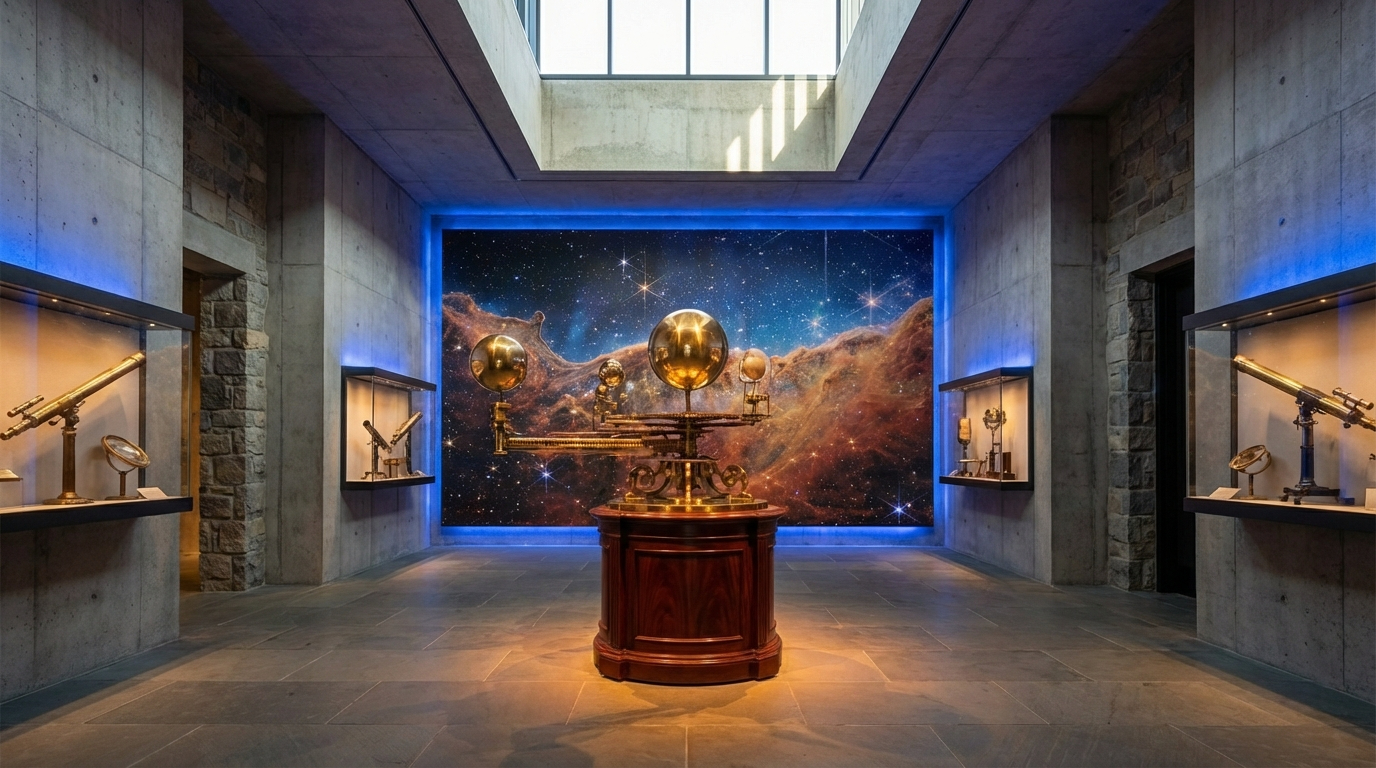
The north tower contains a single, high-ceilinged room with instruments for looking at the sky. The door opens to a brass orrery, eight feet in diameter, mounted on a mahogany stand at the center of the floor. The orrery is a mechanical model of the solar system, built in 1973 from a design published by John Rowley in 1712. The planets are polished brass spheres fixed to brass arms that revolve around the sun — a larger, golden sphere at the center. Visitors may crank a handle on the base to turn the mechanism. The hand crank is worn smooth. When cranked, the planets move in their orbits, their relative speeds determined by gear ratios. The Mercury sphere moves fastest, completing its orbit in the time it takes Jupiter to travel a quarter of its circuit. The mechanism was overhauled recently; the curator's log notes the replacement of the main axle bearing and a new application of a molybdenum-based synthetic lubricant rated for controlled environments.
The Galileo Telescope
On the east wall, mounted at approximately 1.5 meters, is a reproduction of an early refracting telescope of the type used by Galileo. The tube is leather-wrapped wood, approximately three feet long, narrowing toward the eyepiece end. The objective lens is housed in a brass cell with external brass focusing threads. The eyepiece is set in a smaller brass mount and magnifies the image twenty times. The instrument does not magnify with the clarity of later designs, but it performs the function it was built for: it reveals what the unaided eye cannot see. A small printed label beside the telescope notes that it was built from seventeenth-century optical specifications, hand-ground glass, and replica hardware cast from period molds.
Hubble Deep Field
The north wall of the tower is devoted to a single image. The Hubble Deep Field photograph is ten feet wide and fourteen feet tall, mounted behind UV-protective acrylic on a textile base that has been treated to resist degradation. The photograph shows approximately three thousand galaxies in a field of sky smaller than one square arc-minute. The galaxies are spiral, elliptical, and irregular. Some are so distant that their light left them billions of years ago. Most are so distant that they have no names. The image was taken by the Hubble Space Telescope in 1995. It was meant to demonstrate that space is not empty, but populated. The point was made.
Charts and Instruments
The west alcove contains cases of navigation and star charts. One case holds a set of real celestial charts on vellum, hand-drawn and labeled in the astronomical style of the nineteenth century. The constellations are marked and named. Latitude and longitude grids are ruled in ink. These charts were used for actual navigation. In the case beside them, reproductions of star charts from science fiction novels are displayed. One shows the galactic structure described in Asimov's Foundation series — the map of human space, spanned by starships, drawn from technical appendices. Another shows the known galaxy as imagined by Lem before he wrote of Solaris. The charts sit beside each other without explanation. One was drawn to describe a reality that existed. The other was drawn from imagination. Both are charts.
Below the charts, a glass case contains planetary geology samples and plaster casts. Fragments of meteorite. A cross-section of a pallasite, iron and olivine striped. Photographs of basalt formations from volcanic regions on Earth, annotated for color and texture. A series of spheres representing planetary bodies to scale relative to one another, cast in a dense stone material, each one labeled with diameter and atmospheric composition where it exists.
Reflector Telescope Mirror
A section of modern reflector telescope mirror — a parabolic segment approximately two feet across, coated with aluminum and protected by a thin layer of silicon monoxide. The mirror is mounted in a display stand at an angle, and a small light source illuminates it to show the reflective surface. The segment was cut from a larger mirror that was being refigured after stress fractures developed. The base of the stand includes a detailed description of how parabolic mirrors focus light to a point, and how the shape must be accurate to within micrometers to achieve useful magnification.
The Reading Alcove
In a sheltered alcove on the south side of the tower, there is a wooden bench and a low table with two books laid open. One copy of Stapledon's Star Maker, first edition, 1937, Methuen, London. The binding is cloth, faded to tan. The pages are yellowed. The second copy is Lem's Solaris, first Polish edition, 1961, translated to English, 1970. This copy shows water stains on the lower pages, darkening in the margin. Both books are in condition worn by reading. Visitors may sit on the bench and read. The books are replaced quarterly.
The Solaris Room
Beyond the alcove, accessible by a doorway in the south wall, is a separate room. The room is approximately thirty feet long and twenty feet wide. The floor is a continuous expanse of dark water — not shallow, but not truly a pool. The water is still. Its surface shows no ripples. Along the walls, the water meets polished dark stone. The stone is seamless. Recessed lights in the ceiling cast a cool, even illumination that seems to come from the water itself. The air is cool and carries a faint saline quality. The quality of light and water and silence is sustained as you stand in it. It does not change. It does not respond. It is what Lem described when he wrote of the ocean of Solaris — a surface, a presence, indifferent and unknowable. The room contains no interpretation. It is only itself. Visitors may enter and stand or sit on chairs placed at the water's edge. They do not remain long.
Collection Notes
- Rowley orrery Brass, mahogany stand. Built 1973 from original 1712 design. Eight-foot diameter. Recently overhauled; main axle bearing replaced, synthetic molybdenum lubricant applied. Hand crank operational.
- Galileo telescope reproduction Leather-wrapped wood tube, brass eyepiece and objective housing. Twenty-power magnification. Built from seventeenth-century specifications. Hand-ground optical glass. Hardware cast from period molds.
- Hubble Deep Field photograph Ten feet by fourteen feet. Mounted on textile base with UV-protective acrylic facing. Taken 1995 by Hubble Space Telescope.
- Reflector telescope mirror segment Parabolic aluminum-coated surface, silicon monoxide protective layer. Two-foot diameter section. Salvaged from reground mirror after stress fracture repair.
- Celestial navigation charts Hand-drawn on vellum, nineteenth century style. Real astronomical grids. Constellation labels in period notation. Used for actual navigation. Recovered from a private collection in Scotland.
- Asimov Foundation galactic map Reproduction star chart from Foundation series technical appendices. Shows galactic structure as Asimov conceived human space. Vellum, ink notation.
- Lem pre-Solaris star chart Reproduction star chart from Lem's notes before Solaris was written. Imagined galaxy mapped from his working papers. Vellum, ink notation.
- Stapledon, Star Maker First edition, 1937. Methuen, London. Cloth binding, faded. Pages yellowed. Binding loose at spine. Recovered from a library disposal in Sussex.
- Lem, Solaris First Polish edition, 1961. English translation, 1970. Water stains, lower pages and margin. Recovered from a flood-damaged archive in Warsaw. Dried and preserved.
- Meteorite fragments and pallasite cross-section Iron and olivine pallasite, natural cross-section showing striping. Meteorite fragments labeled for composition. Recovered from a geological collection, storage facility closed. Status of remaining collection unknown.
- Planetary geology photographs and casts Basalt formation photographs from volcanic regions, annotated for color and texture. Sphere casts in dense stone, scaled to relative planetary size, labeled for diameter and atmospheric composition.