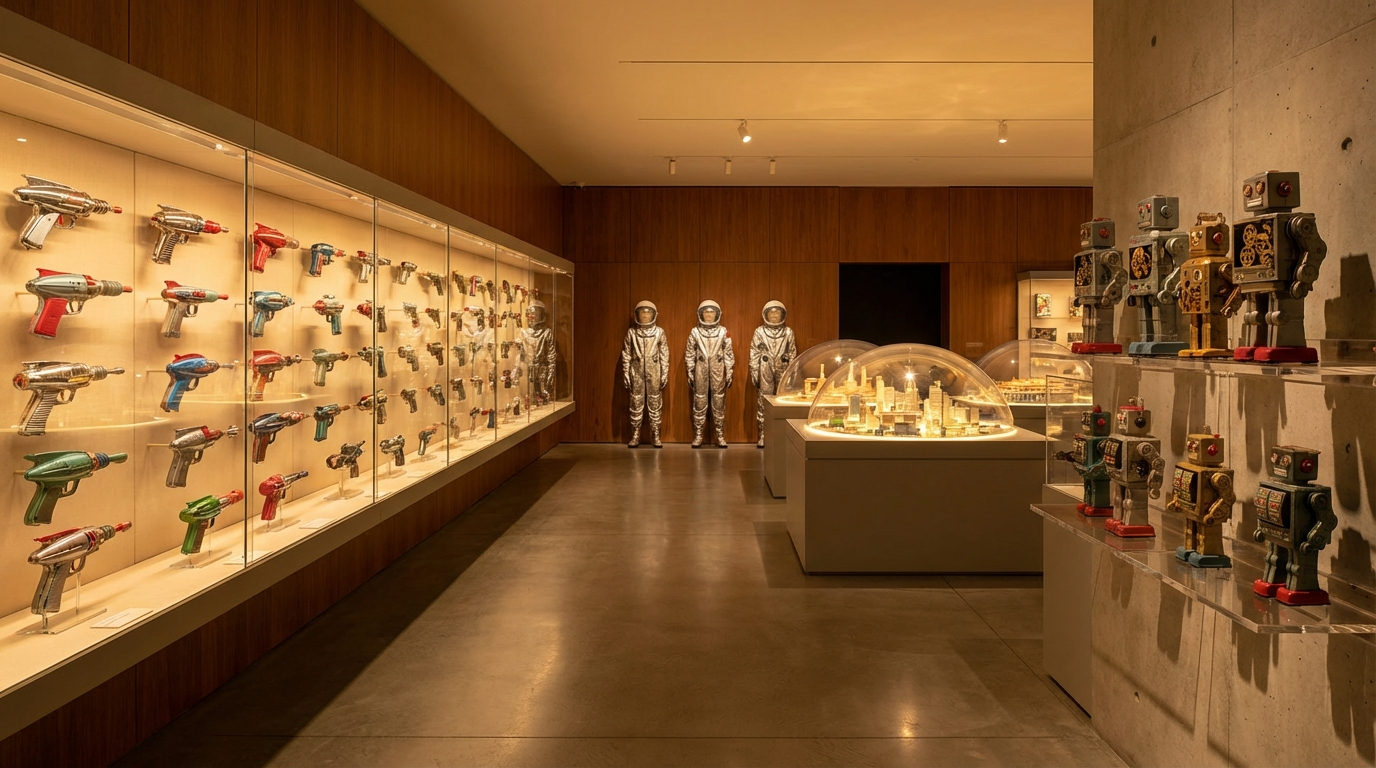
The Ray Gun Collection
A curved glass case runs the length of the north wall, forty-seven ray guns spanning 1930 to 1975. Each is mounted individually on a stand, lit from above and below. The guns are arranged chronologically, starting with pressed-tin models from the early 1930s and ending with molded-plastic designs from the early 1970s.
The earliest pieces occupy the western end of the case. A 1932 ray gun: pressed tin, painted silver, simple tube barrel, flared grip. A 1935 model, same material, slightly more refined proportions. A 1938 die-cast piece, darker and more solid, tapered muzzle. A 1940 design: painted wood and metal, angled sight, trigger guard. These early guns are crude by later standards, but the intent is clear in every line — objects designed for speed, for efficiency, shaped by the descriptions in pulp magazines and novels of the period.
Each placard carries the same information: manufacturer, date, materials, dimensions, original price when known. Moving eastward, the prices appear: "25 cents" (1935), "65 cents" (1948), "$1.50" (1958), "$3.95" (1970). The progression of price mirrors the progression of manufacturing sophistication.
A 1952 chromed brass model, slender and elegant, with a curved guard. A 1958 piece in plastic and die-cast metal, bright electric blue, with ridged grip patterns. A 1962 gun: chrome over aluminum, two barrels, selector switch, clearly descended from the rifles being manufactured in actual factories. A 1968 model: orange and white plastic, dark trigger guard, sight port on top. A 1973 gun: sophisticated molded plastic, weight distributed for balance, textured grip surfaces. By 1975, the end of the range, the form had stabilized into what it would remain.
Displayed alongside the guns, in the same case, are the novels from which they descended. Buck Rogers novels. Early pulp magazines. First editions where available. The guns and the books share the glass, under the same lights.
Japanese Tin Robots: 1950s and 1960s
The east wall displays a collection of robots manufactured in Japan, mounted on clear acrylic stands at angles that allow inspection of the mechanisms visible through transparent panels.
A 1955 wind-up walker: tin, silver with red accents. The wind-up key is mounted on the back; the hole where it fits is visible in the mounted photographs. Through a panel on the chest, the clockwork is visible—gears, springs, a cam mechanism. When wound, the placard notes, the robot would walk forward in a lurching gait, arms swinging rhythmically. The placard lists: manufacturer (a Tokyo company, name in Japanese characters and English translation), date, materials, dimensions (7 inches tall), mechanism type. The robot is in excellent condition; the paint is bright, the clockwork moves freely when hand-rotated gently through the transparent panel.
A 1959 battery-powered model, more angular in design, silver tin with yellow stripes. The torso is mostly closed, but a panel on the right side shows gears and a metal lever. An improvement over the wind-up design: an electric motor draws power from batteries rather than a spring, allowing more consistent forward motion. The placard notes this advancement explicitly.
A 1962 robot, eighteen inches tall, finished in brushed aluminum with blue enamel accents. Two transparent panels, front and back, reveal an intricate mechanism—a dozen visible gears, a motor housing, what appears to be a circuit board with visible copper traces. The robot could walk, raise its arms, and produce mechanical sounds, all powered by two AA batteries. The placard describes its functions precisely. Beside it, a historical note: Čapek wrote R.U.R. in 1921 and described the artificial workers; Asimov wrote his robot stories beginning in 1939. The Japanese manufacturers were building physical replicas of these literary machines, manufacturing them in series, selling them for prices now listed on small cards beneath each robot's stand.
Below, smaller robots sit in rows: tin walkers in primary colors, plastic models with friction-drive mechanisms, a clockwork figure in helmet and suit. Each carries a placard with year, origin, and mechanism type. The condition of the collection is excellent throughout. These objects were manufactured in series, sold at retail, and survive as industrial design — the literal translation of imagination into metal and spring.
Spacesuits Reconstructed from Literature
Three mannequins stand against the west wall, each wearing a spacesuit reconstructed from descriptions found in novels. No film or television production provided these garments. They were built from text.
The first suit was constructed from Heinlein's Have Space Suit—Will Travel, published in 1958. In that novel, the protagonist purchases a surplus pressure suit and repairs it. The suit Heinlein described—named Oscar by the protagonist—is rendered here in silver fabric, one-piece design, with transparent acrylic helmet and articulated gloves. The construction notes, mounted beside the display, reference specific passages from the novel describing the suit's condition when purchased, its repairs, and the young man's modifications. The suit is precise in its details: seams reinforced as Heinlein described, flexibility in the joints, visible patches where repairs were made.
The second suit was built from Clarke's A Fall of Moondust. Clarke's descriptions of lunar surface equipment were technical and specific—the suit had to function in a particular environment, at particular pressures, with particular thermal requirements. This suit is more fitted than the first, with a separate helmet connected to the collar via a heavy clasp. The visor is a curved transparent panel, slightly tinted blue. A control panel is mounted on the left forearm, with small switches and indicator lights. A thick belt carries equipment pouches. The boots are molded plastic with treads. The collection notes identify the passages Clarke wrote that informed this reconstruction.
The third suit was built from Verne's descriptions in From the Earth to the Moon and Around the Moon. Verne was among the earliest to imagine protective garments for travel beyond the atmosphere, though his descriptions were less precise than Clarke's or Heinlein's. This suit is the most elaborate — multi-layered at the seams, reflective silver with tonal variations showing the layers underneath. The helmet is a large sphere of acrylic, tinted slightly amber. A gold-plated reflective surface inside the visor replicates the original protection function. The gloves are bulky with rigid pressure seals at the wrist. A life support pack is mounted on the back. The suit bears markings in blue and red — identification numbers, warning stripes, status indicators. The novels themselves are displayed in cases beside each suit.
Domed City Models
The central alcove holds three models of domed cities, each interpreting a literary description as architectural possibility.
The largest, at 1:500 scale, measures approximately five feet in diameter. The dome is transparent acrylic, clear enough that the interior is fully visible. Beneath the dome: green landscape representing parks and vegetation, white buildings arranged in geometric patterns, elevated roadways in silver, water features in blue plastic. At the center, a taller building—perhaps governmental, perhaps cultural. Interior streets and transit lines are rendered in fine detail; small vehicles sit at rest on the roadways. The model is based on descriptions from Asimov's The Caves of Steel, and the collection notes reference the passages describing the city beneath the dome.
A smaller model at 1:1000 scale, one foot in diameter, emphasizes the structure of the dome itself. The geodesic framework is visible through clear acrylic—the triangular panels and bracing that would hold such a structure. The interior is simplified, showing functional divisions of the city. This model is an earlier concept, less fully imagined.
The third model, 1:300 scale, eight feet across, is the most complex. The dome is sliced away, revealing the interior three-dimensionally. Buildings rise from the ground in honeycomb arrangement. Green areas occupy spaces between structures. A transit system rendered in brass wire runs elevated through the city. The model is lit from above, casting shadows that emphasize the depth. A placard notes that this model is based on architectural proposals from the 1960s for a lunar settlement, which themselves were informed by decades of literary description. The layering of influence—novel inspiring architecture inspiring model—is explicit in the text.
Illustrated Scenes from Novels
The south wall displays original paintings created by artists working from novel passages. These are not production artwork from films or television. These are scenes imagined by authors, rendered on paper by artists who read those descriptions and translated them into visual form.
A 1958 painting: a scene from an early space novel, control room interior, white walls, curved screens showing star fields and readouts, a crew member in silver suit standing before the displays, the lighting cool blue and white. The artist worked from written description; the painting captures the artist's interpretation of that description.
A 1962 painting: an alien landscape from a novel—red sand, purple sky, distant mountains, a human figure in silver suit standing alone. The passage the artist worked from is mounted beside the painting in a small frame. The viewer can compare the text to the image, see how description became color and form.
A 1967 painting: spacecraft interior from a novel—corridors lined with ribbed walls, individual pods arranged in rows, emergency lights glowing amber in shadows. Again, the source passage is displayed.
A 1971 painting: domed city interior at dusk, lights glowing in buildings, elevated roadways with vehicles, green areas in shadow, the dome itself faintly visible at top, stars showing through. This painting is based on a passage from a novel about life beneath the dome. The author's words and the artist's watercolor hang side by side.
Thirty paintings hang individually on the south and west walls, each lit by a focused fixture, each paired with the passage from the novel that inspired it. The paintings are rendered in acrylic, watercolor, and gouache. Many show evidence of working—corrections visible, preliminary sketches showing through, brush strokes apparent at magnification. These are working documents of translation: from prose to image, from word to pigment.
Personal Flight: The Bell Rocket Belt and Its Precursors
Along the west wall, a full-scale reproduction of the Bell Aerosystems Rocket Belt hangs from a mounting bracket. The device measures five feet from top to bottom. The backpack section is metallic silver, with two hydrogen peroxide tanks mounted vertically along the spine. Aluminum tubing extends downward, with foot platforms and hand controls visible. Two thrust nozzles protrude from the lower ends of the frame. A small control panel mounted on the right side shows switches and a throttle lever. This was a real device, built and tested in the early 1960s, based on decades of literary descriptions of personal jetpacks—machines that Verne, then later science fiction writers of the twentieth century, had imagined.
Beside the rocket belt, a series of magazine illustrations and technical drawings shows jetpack designs from various eras. A 1948 concept drawing from a pulp magazine shows a sleek device with a single vertical thruster. A 1956 illustration shows a boxy design with stubby wings. A 1965 photograph shows a person standing on a jetpack in a silvered suit, feet on broad platforms, hands gripping vertical handles. A 1972 technical drawing details fuel system, turbine, and thrust vectoring mechanism. The evolution is visible in sequence: imagination → concept drawing → engineering → prototype → photograph. The Bell Rocket Belt flew. Verne, decades earlier, had written that it would.
Collection Notes
- Ray gun, 1932, pressed tin Silver paint, simple barrel, flared grip. Manufacturer unknown. Recovered from a house clearance, Los Angeles. Fair condition; paint worn, mechanism intact.
- Ray gun, 1935, pressed tin, Hubley Manufacturing Silver paint, refined proportions. Original price 25 cents marked on original box, recovered with artifact. Condition excellent.
- Ray gun, 1938, die-cast metal Darker finish, tapered muzzle. Manufacturer identified as Eastern firm. Condition good; light oxidation on metal.
- Ray gun, 1940, painted wood and metal Angled sight, trigger guard. Mixed materials suggest wartime manufacturing. Recovered from a residential shelf, condition fair.
- Ray gun, 1952, chromed brass Slender elegant design, curved guard. Manufacturer marking faint but identifiable. Condition excellent; chrome bright.
- Ray gun, 1958, plastic and die-cast metal, electric blue Ridged grip patterns. Original price $1.50. Recovered with original box. Condition excellent; paint vibrant.
- Ray gun, 1962, chrome over aluminum Two barrels, selector switch. Shift in design toward functional complexity. Condition excellent.
- Ray gun, 1968, plastic, orange and white Dark trigger guard, sight port on top. Molded plastic construction. Condition excellent; slight sun fading on orange.
- Ray gun, 1973, molded plastic Final design in collection. Weight balanced for hand, textured grip surfaces. Condition excellent. Final piece in manufacturing run 1930–1975.
- Buck Rogers novels, early pulp magazines First editions where available. Mixed condition. Recovered from private libraries and residential shelving. Pages show reading and wear consistent with period purchase and use.
- Japanese tin robot, 1955, wind-up walker Silver tin with red accents. Tokyo manufacturer. Wind-up mechanism visible through chest panel. Gears, springs, cam mechanism intact and functional. Dimensions 7 inches. Condition excellent.
- Japanese tin robot, 1959, battery-powered Silver tin with yellow stripes. Tokyo manufacturer. Electric motor, visible through side panel. Improved mechanism allowing consistent motion. Dimensions 9 inches. Condition excellent.
- Japanese tin robot, 1962, multi-function Brushed aluminum with blue enamel. Eighteen inches tall. Transparent panels reveal intricate gear train, motor housing, circuit board. Walking, arm movement, sound production functions. Two AA batteries. Condition excellent.
- Robot replicas, smaller models, 1950s–1960s Tin walkers, friction-drive plastic models, clockwork figures. Tokyo manufacturers. Various dimensions 4–6 inches. All in excellent condition.
- Spacesuit reconstructed from Heinlein, Have Space Suit—Will Travel Silver fabric, one-piece, transparent acrylic helmet, articulated gloves. Reconstructed from novel passages describing Oscar, the protagonist's surplus pressure suit. Collection notes reference specific chapters describing condition and repairs. Built to specifications derived from text.
- Spacesuit reconstructed from Clarke, A Fall of Moondust Silver fitted fabric, separate helmet with blue-tinted visor, forearm control panel, equipment belt, rigid molded-plastic boots. Reconstructed from novel passages describing lunar surface equipment. Technical specifications derived from Clarke's descriptions.
- Spacesuit reconstructed from Verne descriptions Multi-layered reflective silver, large amber-tinted spherical helmet, gold-plated reflective visor interior, bulky gloves with rigid pressure seals, back-mounted life support pack. Reconstructed from passages in From the Earth to the Moon and Around the Moon. Among the earliest literary descriptions of protective garments for space travel.
- Domed city model, 1:500 scale Five feet diameter, transparent acrylic dome. Interior landscape, buildings, roadways, transit system, parks, water features. Based on Asimov's The Caves of Steel descriptions. Collection notes reference specific passages. Condition excellent.
- Domed city model, 1:1000 scale One foot diameter, transparent acrylic showing geodesic framework, triangular panels, bracing structure visible. Simplified interior showing functional city divisions. Condition excellent.
- Domed city model cross-section, 1:300 scale Eight feet diameter, dome sliced away revealing interior three-dimensionally. Honeycomb building arrangement, elevated brass-wire transit system, green areas. Lit from above. Based on 1960s lunar settlement architectural proposals. Condition excellent.
- Illustrated scenes from novels, collection of 30 paintings Acrylic, watercolor, and gouache on paper. 1950s–1970s. Artists working from novel passages; each painting paired with the source text mounted beside it. Subjects include control rooms, alien landscapes, spacecraft interiors, domed city interiors. Scale 18" × 24" to 48" × 60". Individually lit. Mounted in simple aluminum or wood frames. Condition excellent. Visible evidence of artist's working process.
- Bell Aerosystems Rocket Belt reproduction Full-scale, five feet height. Metallic silver paint. Hydrogen peroxide tanks, aluminum frame, thrust nozzles, control panel. Mounted on wall bracket. Replica of historical device tested in early 1960s. The moment when technical capability matched literary description. Condition excellent.
- Jetpack concept drawings and technical illustrations Magazine illustrations and technical drawings spanning 1948–1972. 1948 concept drawing, single vertical thruster design. 1956 illustration, boxy design with wings. 1965 photograph, person on jetpack, silvered suit. 1972 technical drawing, fuel system and thrust vectoring detail. Various formats and media. Condition fair to good; some color fading consistent with age.