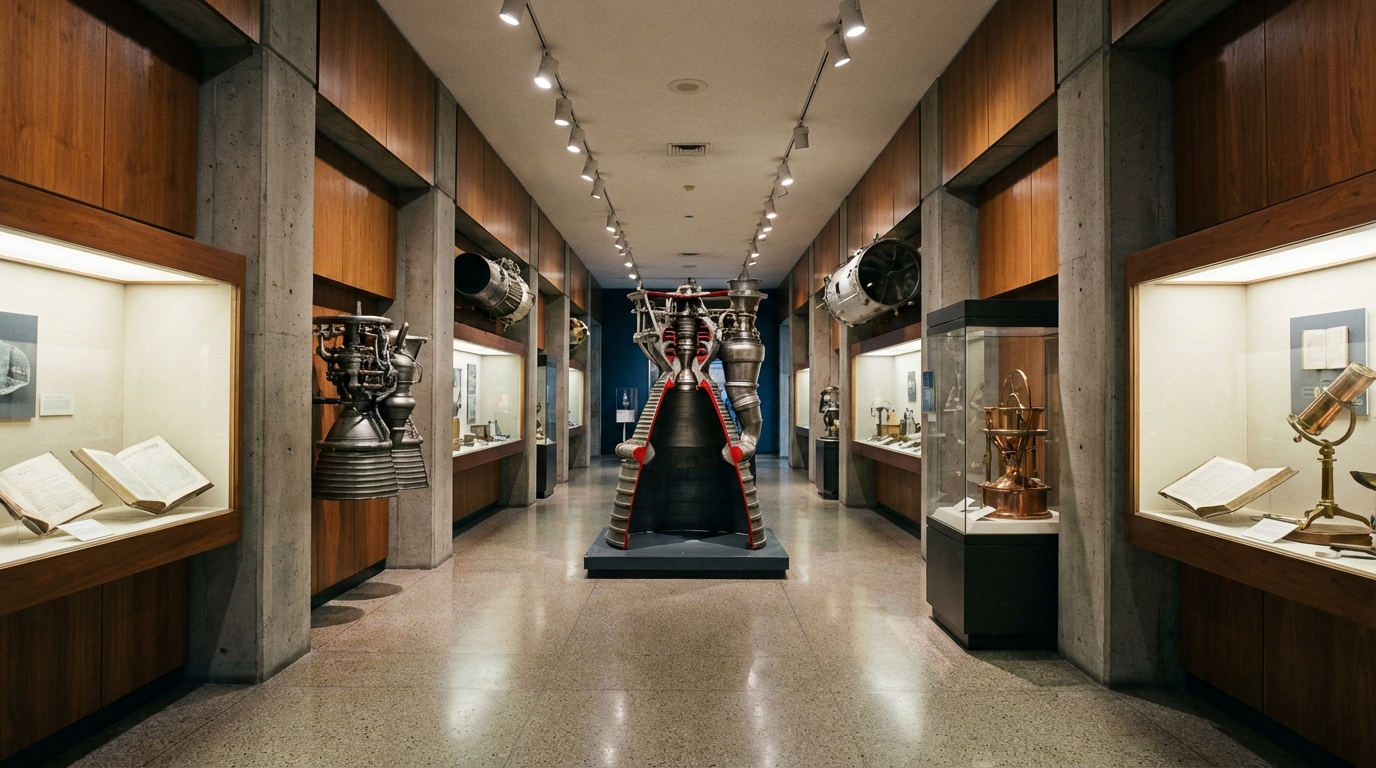
The gallery is arranged chronologically, beginning at the entrance and moving deeper. The first object is a full-scale reproduction of Robert Goddard's 1926 liquid-fueled rocket — ten feet of iron tubing, copper coils, and valve assemblies. This was the first. The frame is delicate; the proportions are fragile compared to what comes later. A case beside it holds Goddard's hand-drawn sketches, reproduced from the originals. Above the case, Tsiolkovsky's rocket equation in his handwriting on vellum — the relationship between exhaust velocity, mass ratio, and final speed, written in 1903, twenty-three years before Goddard's rocket left the ground.
Beside the Tsiolkovsky, a first edition of Verne's From the Earth to the Moon, open to the description of the Columbiad cannon's propellant calculations. A handwritten annotation in the margin reads: "36,000 feet per second — correct." The annotator is unknown. The book predates both men's work by decades.
Chemical Propulsion
Past Goddard, the gallery widens. A cutaway model of the F-1 engine at quarter scale — the engine that powered the Saturn V's first stage — stands ten feet tall at the corridor's center. The combustion chamber is exposed, showing the tubular fuel injector and the cooling channels etched into the walls. A placard notes the thrust: one and a half million pounds per engine. The Saturn V carried five.
The east wall displays the evolution of propellant chemistry. Solid rocket fuel samples sit sealed in acrylic blocks — the mixture of ammonium perchlorate and aluminum used in the Space Shuttle's boosters, its orange-gray color distinctive. Beside it, a transparent sample of hydrazine's crystalline form, and a sealed tube of liquid oxygen kept cold in an insulated case with a copper cooling coil. A hand-printed sign notes the temperature: minus 183 degrees Celsius. Condensation never forms on the glass.
A working hydraulic press is mounted at the center of the east wall. A lever compresses a platform, and a dial above it shows the force in newtons. Printed cards beside the dial note the equivalent thrust: this much force equals the opening sequence of a Mercury-Atlas launch. This much equals Gemini. All the way down equals five F-1 engines. The brass dial is worn smooth.
Nuclear and Ion Drives
The corridor narrows and the objects change. A scale model of the NERVA nuclear thermal engine sits in a sealed case — the engine that was designed, tested, and then cancelled before it flew. Beside it, Heinlein's Rocket Ship Galileo, first edition, 1947, in which three teenagers and a physicist fly a nuclear-powered ship to the Moon. Heinlein described the engine eleven years before the NERVA program began. The novel is open to the chapter where the physicist explains the principle: heat a propellant with a reactor, expel it through a nozzle. The NERVA model beside it does exactly that, rendered in aluminum and steel at one-tenth scale.
Deeper in, an ion drive model. The engine is small — the thruster assembly is no larger than a dinner plate. A placard explains the principle: ionize a gas, accelerate the ions through an electric field, produce thrust. The thrust is small. The efficiency is high. Beside the model, Clarke's 2001: A Space Odyssey, open to the passage describing Discovery One's propulsion — a nuclear-electric drive, essentially an ion engine at scale. The novel specifies the exhaust velocity. The model's placard lists the same figure.
Drives from the Novels
The south corridor opens into a larger room. The engineering models here are built from descriptions in text.
A Bussard ramjet occupies the center of the room, mounted on a steel cradle at one-twelfth scale. The model is four feet long. The magnetic scoop — a wide funnel of copper wire wound in concentric rings — flares from the bow. Behind it, a narrow fuselage and a reaction chamber. The design is taken from Niven's A World Out of Time, first edition, 1976, which sits in the case beside the model. Niven describes the ramjet's operation: the scoop collects interstellar hydrogen, compresses and fuses it, and expels the products as thrust. The novel specifies the scoop diameter at several hundred kilometers. The model scales this to thirty-four centimeters. A technical drawing on the wall behind the model shows the full-scale configuration with dimensions annotated.
To the east, a torchship drive assembly built from the specifications in Heinlein's Time for the Stars, 1956. The model shows a reaction mass tank feeding into a shielded chamber — the novel describes a ship that accelerates at one gravity continuously, reaching relativistic speeds. A diagram beside the model plots the trajectory: acceleration for half the journey, deceleration for the second half, arriving at Tau Ceti in eleven years ship-time. The mathematics are printed on the wall in Heinlein's notation, transcribed from the novel.
At the far end of the room, a smaller model sits alone in a glass case. This is the Stutterwarp drive from Cherryh's Downbelow Station, 1981 — a jump drive that moves a ship between points by compressing the space between them. The model is abstract: a frame of brass rods surrounding a central sphere, with calibration markings etched into the sphere's surface. The novel describes the drive's effects but not its mechanism in full. The model represents what the text provides and nothing more. A note in the collection file reads: "Built from pages 44–47 of the first edition. Structural interpretation only."
Thrust Demonstration
The hydraulic press measures force in real time. The gauge registers up to ten thousand newtons. At full extension, the force equals three Saturn V F-1 engines. The mechanism was installed two years ago. The placard on the original lever read "Not for Public Use." That placard was removed last spring.
Collection Notes
- Goddard liquid-fueled rocket reproduction Full scale, 1926 design. Iron and copper. Tubing restored. Recovered schematics from Smithsonian archive.
- Tsiolkovsky rocket equation Facsimile on vellum, 1903. Original in Russian State Archive at time of transcription.
- F-1 engine model (Saturn V) Quarter scale, cutaway. Aluminum construction. Height: 10 feet.
- NERVA nuclear thermal engine model One-tenth scale. Aluminum and steel. Built from declassified program documents.
- Ion drive thruster model Full scale. Based on NASA design specifications and Clarke's description in 2001.
- Bussard ramjet model One-twelfth scale, four feet. Copper scoop, steel fuselage. Built from Niven, A World Out of Time, 1976.
- Torchship drive assembly Scale model. Built from Heinlein, Time for the Stars, 1956. Trajectory mathematics transcribed from text.
- Stutterwarp drive model Brass and steel. Built from Cherryh, Downbelow Station, 1981, pages 44–47. Structural interpretation only.
- Solid rocket fuel sample Space Shuttle booster propellant. Sealed acrylic block.
- Liquid oxygen sample (sealed) Temperature maintained at −183°C. Copper cooling coil.
- Hydraulic thrust demonstration press Operational. Installed two years ago. Lever mechanism replaced last spring.
- Verne, From the Earth to the Moon First edition, 1865. Annotated in pencil, author unknown. Open to propellant calculations.
- Heinlein, Rocket Ship Galileo First edition, 1947. Scribner's. Dust jacket missing. Recovered from a library. Deaccession stamp on title page.
- Clarke, 2001: A Space Odyssey Reading copy. Open to propulsion passage. Second printing, 1968.
- Niven, A World Out of Time First edition, 1976. Holt, Rinehart and Winston. Condition: good. Spine slightly faded.
- Heinlein, Time for the Stars First edition, 1956. Scribner's. Dust jacket intact. Recovered from a private residence, Pasadena.
- Cherryh, Downbelow Station First edition, 1981. DAW Books. Pages 44–47 marked with archival tabs. Condition: good.