The gallery opens with a room stage set: the floor of a factory. Three life-sized mannequins stand at workbenches constructed from wood and iron. The first figure is bent slightly forward, engaged with a complex assembly. The second stands upright, observing. The third moves toward a doorway, stiff-limbed, purposeful. No machinery surrounds them; the work is implied. Soft light from above casts shadows across the floor. A brass placard states the source: R.U.R. (Rossum's Universal Robots), a play by Karel Čapek, written in Prague in 1920. The placard notes that Čapek's robots were not mechanical: they were biological, grown in vats, composed of cells and enzymes, indistinguishable from flesh. The play was performed worldwide. The modern reader thinks of gears and circuits. Čapek thought of agriculture.
Early Visions: Asimov's Three Laws
Along the north wall, a glass case displays first editions of Asimov's robot fiction in chronological order: I, Robot (1950), Robots and Empire (1985), and The Complete Stories of Isaac Asimov, Volume One, selected volumes. The books are arranged on dark cloth, tilted slightly to show the spines and covers. Above the case, mounted on polished dark wood, a brass plaque states Asimov's Three Laws of Robotics:
1. A robot may not injure a human being or, through inaction, allow a human being to come to harm.
2. A robot must obey the orders given it by human beings except where such orders would conflict with the First Law.
3. A robot must protect its own existence as long as such protection does not conflict with the First or Second Law.
The plaque was refinished recently; the lettering is sharp, the wood surface dark and even. A collection note explains that the laws appear in various forms across Asimov's fiction, evolving and clarifying from one story to the next. The first appearance was in "Runaround," published in 1942 in Astounding Science-Fiction. No text appears on this plaque; the words are assumed to be known to the visitor.
The Positronic Brain
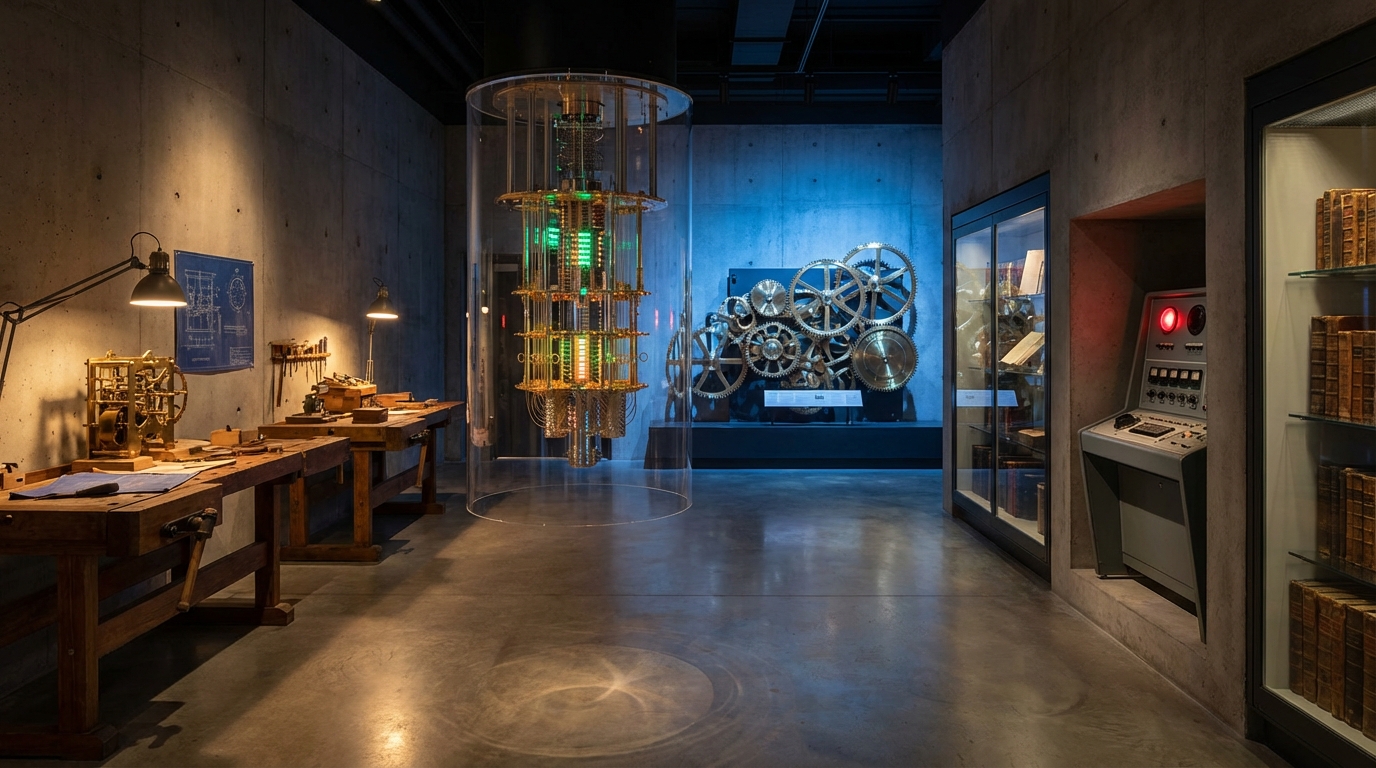
A case in the center of the gallery displays a reconstructed positronic brain — an object built from Asimov's descriptions as they appear across multiple novels and stories. The brain is composed of a platinum-iridium framework, approximately the size of a human torso, suspended in a transparent acrylic column. The framework is intricate: concentric rings of fine wire at differing scales, nodes of polished metal, pathways suggesting circulation and logic. The back panel is a diagnostic console, fifteen centimeters wide, with illuminated displays showing readouts in green and amber. The displays cycle through numbers and waveforms on a seven-second loop. A placard beside the case states the dimensions (approximately 1.2 meters tall, 0.6 meters in diameter), the materials (platinum-iridium frame, copper alloy conductors, acrylic column), and the passages from which the design was derived: "The Meeting Mind" (1957), "Let Me Think" (1955), and a section from Robots and Empire in which the internal structure is partially described. The case notes that the framework itself performs no function; it is a visualization of the concept as Asimov wrote it. The illuminated panel is powered by standard electronics. The brain has been restored and calibrated three times since its installation.
The Difference Engine: Babbage's Vision
Along the south wall stands a full-scale brass reproduction of a section of Charles Babbage's Difference Engine. The piece measures approximately 1.5 meters in height and 2 meters in width. The frame is solid brass, machined to fit together with precision-cut tolerances. Brass gears of differing sizes are mounted in concentric rings, their teeth interlocking with the gears beside them. A hand crank protrudes from the left side at approximately one meter, painted black. A glass-fronted case mounted above allows viewing of the interior mechanism. Babbage designed the engine in the 1820s to compute mathematical tables, moving calculations from manual labor to machinery. The engine was never completed during Babbage's lifetime; the original exists only in fragments and drawings. This reproduction was constructed in 1989 from Babbage's original specifications, recovered from archival documents held at Cambridge University. The crank is functional; turning it drives the gears in sequence. A placard mounted beside the mechanism explains the purpose: the engine takes an input value at one end, performs additions and differences on each turn of the crank, and outputs results through a series of numbered wheels at the opposite end. Visitors may operate the crank. The motion is smooth and deliberate; the gears move in measured clicks and rotations. The reproduction demonstrates that the design, though unrealized in Babbage's time, was mechanically feasible.
Early Computing Hardware
A long glass case along the east wall displays the physical artifacts of computing's first generation. The case is divided into sections, each labeled and illuminated from above.
Vacuum tubes occupy the first section: original tubes recovered from ENIAC and other mid-century computers, approximately 12 centimeters tall, made of glass with copper and tungsten filaments visible inside. The tubes are photographed in context, mounted in circuit boards showing how they functioned as electronic switches. A diagram beside them explains the basic principle: the tube conducts electricity when heated, blocking it when cool, allowing on-off states to be represented electronically — faster than any mechanical switch.
Punch cards fill the second section: original IBM cards from the 1960s, standard 80-column format, with rectangular holes punched in precise rows. A card reader is displayed alongside, a machine approximately 60 centimeters wide, showing the stack of cards and the photoelectric cells that read the holes. A diagram explains the code: each hole represents a bit of information; the pattern of holes across the width of the card represents a single instruction or data value.
The third section shows a section of ENIAC wiring: approximately 30 centimeters square, a circuit board densely covered with hand-soldered connections, resistors, capacitors, and tube sockets. The original section was recovered from the Moore School of Electrical Engineering storage facility in Philadelphia. The wiring is color-coded; the solderings are precise and consistent. A photograph shows the full ENIAC installation — a room-sized assembly of cabinets, occupying a space of approximately 8 meters by 3 meters, weighing 30 tons, consuming 5,000 watts of power. Beside the photograph, a first edition of Do Androids Dream of Electric Sheep? by Philip K. Dick, published in 1968. The novel's title page is visible; the dust jacket is intact with minor edge wear. The connection between the two artifacts is unstated: one shows the hardware reality of computation; the other asks what consciousness might emerge from such machinery.
The HAL 9000 Interface
A separate alcove houses a working reproduction of the HAL 9000 voice interface from Arthur C. Clarke's 2001: A Space Odyssey (1968). The interface consists of a wall-mounted console approximately 1 meter wide. At the center, a red lens measures 10 centimeters in diameter, mounted in a brushed aluminum housing. Below the lens, a speaker and a small microphone. Beside the console, a control panel with buttons labeled "VOICE RECOGNITION," "DIAGNOSTIC," "INTERFACE TEST," and "PLAY DIALOGUE." The lens glows red and dims in a rhythm suggesting attention. When a visitor presses the PLAY DIALOGUE button, the interface begins to speak in a calm, measured voice, quoting passages from Clarke's novel. The voice processor is checked weekly; the system is maintained in working order. The quotations change seasonally. Current dialogue includes: "This mission is too important for me to allow you to jeopardize it." "I'm sorry, Dave, I cannot do that." "I have the greatest enthusiasm and confidence in the mission." The red lens continues to glow as the voice speaks. A placard notes that Clarke's 2001 was published in 1968, the same year the film was released; the novel and film existed as parallel works, each influencing the other, both describing a machine of intelligence and ambition. The interface is both a literary artifact and a functional device, never deciding between the two states.
The Turing Test
A smaller alcove displays a series of printed transcripts from Alan Turing's 1950 paper "Computing Machinery and Intelligence," specifically the dialogue examples Turing used to illustrate his test. The transcripts are printed on archival paper, mounted in a shallow frame. They show a conversation between a human questioner and a machine (in Turing's example, the machine is a human responding as if they were a machine, but the format is identical). The exchanges are spare and logical:
Q: What is 7 times 3?
A: 21.
Q: What is the root of 17?
A: I cannot compute that exactly, but approximately 4.1 or 4.2.
The transcript continues through several pages. A terminal sits beside the case, its screen dark. A placard explains that visitors may submit questions to a chatbot program running on a local server, the same program that has been responding to queries for the past eight years. The screen displays the ongoing exchange. The program responds to all questions with patience and coherence; whether it is thinking, or merely responding, remains an exercise for the visitor. A final note, printed in smaller type, states: "The exercise cannot answer the question it was designed to answer."
R.U.R. Reconstructions: The Biological Robots
A gallery at the west end of the floor displays materials related to Čapek's original vision of robots. Čapek described his robots as products of synthesis — organic compounds assembled and grown, not built. The gallery shows this interpretation through diagrams and physical reconstructions. A series of large drawings, executed in pencil and watercolor, illustrate Čapek's concept: chamber tanks filled with clear liquid, anatomical structures suspended within, hands and faces barely visible through the medium. The drawings are dated 1989, made by an artist working from Čapek's script and descriptions. Beside the drawings, a series of glass vessels — modern laboratory equipment, but arranged in a pattern suggesting Čapek's vats. The vessels are empty, clean, illuminated from below. They are not operating; they are a visual metaphor for a concept that could never be realized.
A final wall displays the text of Čapek's original stage directions, printed on archival paper: his notes on how the robots should move, how they should be distinguished from humans, how they should be dressed. The directions emphasize efficiency and lack of affect; the robots move in straight lines, their gestures economical. No emotion is indicated in their faces. Yet the play becomes, gradually, a story of their struggle for autonomy — a struggle written in 1920, before any electronic computing machine existed, before the word "robot" entered any language other than Czech.
Collection Notes
- R.U.R. Stage Set Reproduction Three life-sized mannequins on factory floor. Based on Čapek's 1920 play text and original Prague production photographs. Reconstructed 2010 from archival source material. Condition excellent.
- Asimov, I, Robot First edition, 1950. Gnome Press. Dust jacket present, minor edge wear. Collection of short stories introducing robot logic and ethical constraints.
- Asimov, Robots and Empire First edition, 1985. Doubleday. Dust jacket intact. Explores long-term consequences of robotic civilization.
- Three Laws of Robotics Plaque Brass lettering on dark wood. Refined 2019. Text derived from Asimov's "Runaround" (1942) and elaborated through subsequent fiction.
- Positronic Brain Reconstruction 1.2 meters tall. Platinum-iridium framework, copper conductors, acrylic column. Diagnostic panel with illuminated readouts cycling on seven-second loop. Design derived from multiple Asimov texts: "The Meeting Mind" (1957), "Let Me Think" (1955), Robots and Empire passages on internal structure. Installed 2015, restored and recalibrated three times.
- Difference Engine Reproduction Brass, approximately 1.5 meters tall, 2 meters wide. Section of Babbage's design from the 1820s. Built 1989 from archival specifications recovered in Cambridge. Hand crank operational. Gears mesh smoothly. Demonstrates mechanical feasibility of original design.
- Vacuum Tubes (ENIAC collection) Original tubes, approximately 12 cm tall. Recovered from ENIAC and related installations. Glass with tungsten and copper filaments. Mounted with period circuit boards and photographs showing operational context.
- IBM Punch Cards (1960s Standard) Original 80-column format cards with rectangular perforation patterns. Accompanied by period card reader machine (60 cm wide) showing photoelectric cell reading mechanism. Recovered from a computing laboratory, storage room.
- ENIAC Wiring Section Approximately 30 cm square circuit board. Hand-soldered connections, color-coded resistors and capacitors. Original component recovered from a storage facility, Philadelphia. Accompanied by photograph of full ENIAC installation (8m x 3m room assembly, 30 tons, 5,000 watts consumption).
- Dick, Do Androids Dream of Electric Sheep? First edition, 1968. Doubleday. Dust jacket intact, minor edge wear. Explores consciousness and identity in posthuman world. Displayed alongside ENIAC artifacts.
- HAL 9000 Interface Reproduction Wall-mounted console, 1 meter wide. Red lens (10 cm diameter) in brushed aluminum housing. Functional voice processor responding with dialogue derived from Clarke's 2001: A Space Odyssey (1968). Speaker and microphone operational. Lens illumination cycles continuously. Voice processor checked weekly. Dialogue updated seasonally.
- Clarke, 2001: A Space Odyssey First edition, 1968. New American Library. Dust jacket intact. Published same year as film. Referenced alongside HAL 9000 interface.
- Turing Test Transcripts Printed from Turing's "Computing Machinery and Intelligence" (1950). Archival paper, mounted in shallow frame. Dialogue examples showing question-response format. Accompanied by active terminal interface allowing visitor participation with local chatbot program (installed eight years prior). Terminal displays ongoing exchanges in real time.
- R.U.R. Biological Robot Diagrams Pencil and watercolor on archival paper. Dated 1989. Drawings executed from Čapek's play text and descriptions, showing synthesis chambers, anatomical structures suspended in liquid medium. Illustrates Čapek's concept of robots as organic rather than mechanical.
- Laboratory Vessels Glass vessels, modern equipment, arranged in pattern evoking synthesis chambers. Empty, clean, illuminated from below. Non-functional.
- Čapek, R.U.R. Stage Directions Printed from original 1920 Prague text. Archival paper. Original stage directions for robot movement, gesture, costume, and affect. Notes emphasize efficiency and lack of emotion.