Scale Models: The Vessels
Two glass cases dominate the north wall. The first holds a scale model of the ship from Heinlein's Universe at 1:500, displayed against architectural blueprints showing the rotating habitat ring and the dense warren of compartments filling its interior. The ship measures three feet in length; a placard explains that the fictional vessel itself stretched fifteen kilometers end to end. The model's hull is painted steel gray. Ports and access hatches are indicated with white markings. The central drive section angles downward from the rotating ring—a suggestion of engines pushing the craft through centuries of vacuum.
Beside it, at 1:200 scale, is the Aurora from Kim Stanley Robinson's novel of the same name. This model is larger, the ship broader, the proportions less sleek. The Aurora is a generation ship designed for practical habitation. Interior structures are visible through translucent panels: the agricultural bays appear as horizontal bands of lighter material running the length of the hull. The model sits on a brass placard listing the basic specifications: length 2.2 kilometers, diameter 240 meters, carrying capacity 2,400 individuals. The placard notes the ship was launched from Earth in the year 2097, on course for Tau Ceti, 11.9 light-years distant. Transit time: 170 years.
The Habitat Module: A Walk Through Life Support
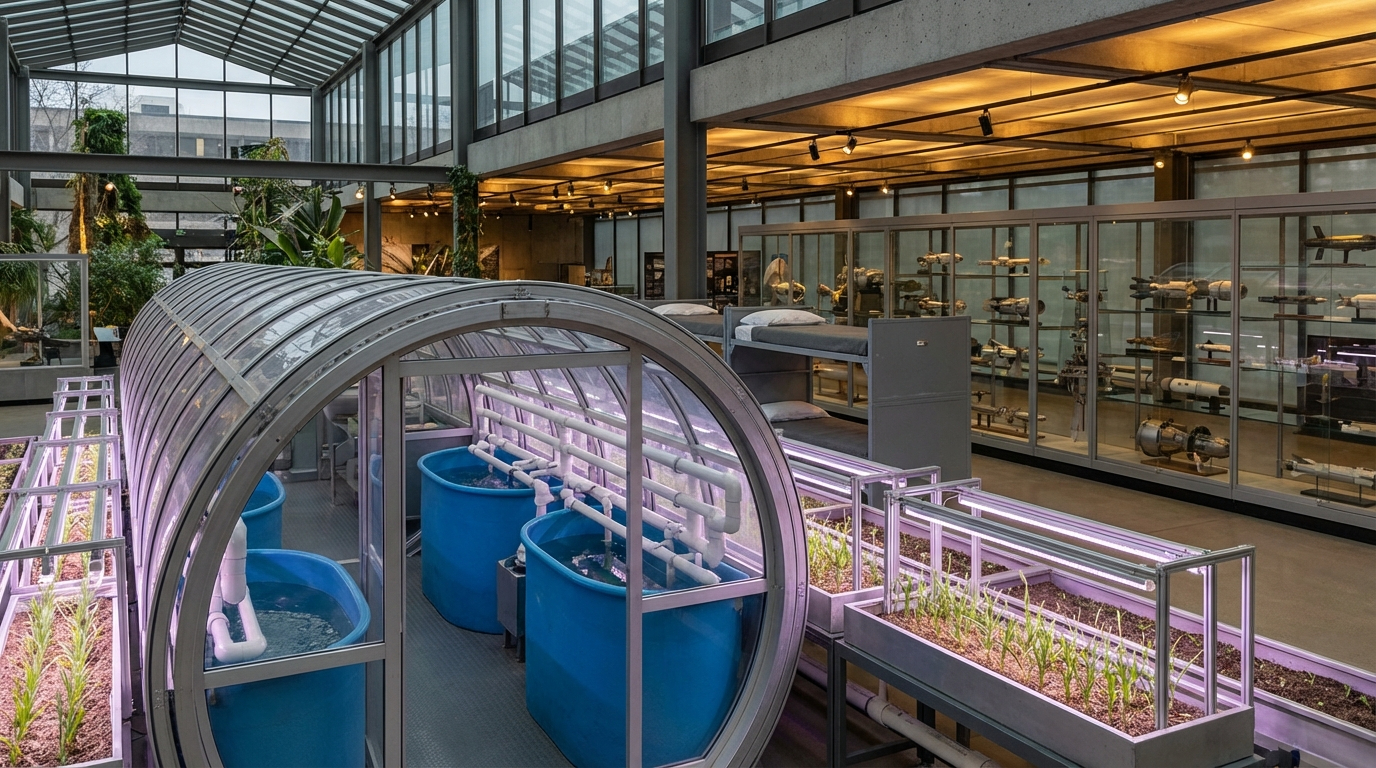
The centerpiece of the gallery is a full-scale cross-section of a generation ship habitat module. Visitors pass through an open doorway and stand inside. The module is cylindrical, roughly twenty meters long and eight meters in diameter. The curved wall on the east side is covered with water reclamation equipment: ranks of blue plastic tanks holding perhaps two thousand liters each, connected by white PVC piping and valves. Labels indicate the function of each system: condensation recovery, greywater filtration, wastewater processing. The pipes run vertically, horizontally, in organized tangles showing the density of machinery required to cycle water through a closed loop indefinitely.
The west wall holds the air reclamation systems. Tall cylindrical carbon dioxide scrubbers stand upright like silent sentries. Smaller molecular sieve units sit on brackets below. A schematic diagram, mounted in a steel frame, shows how the systems work together: exhaled air is drawn through the scrubbers, CO₂ is separated and stored, oxygen is released back into the atmosphere. The diagram is technical, precise, showing flow rates in cubic meters per hour.
The southern end of the module contains agricultural beds—long narrow troughs with soil medium and irrigation lines. The beds are operational. Some contain winter wheat, fourteen centimeters tall, growing under grow lights suspended above. An irrigation line drips at timed intervals, the small sound of water the only movement in the otherwise static display. The northern end has sleeping quarters: six narrow bunks arranged in two columns of three, each with storage cubbies carved into the wall. The fabric covering the bunks is institutional gray. A reading lamp is mounted above each bunk. Dimensions posted on the wall indicate each bunk is 2.1 meters long, 0.8 meters wide, 0.5 meters high.
The Seed Vault Display
Along the east wall of the gallery proper, a case displays rows of glass jars arranged on shelves. Each jar is labeled in white text: wheat, rice, corn, barley, sunflower, soybeans, beans, peas. The jars are sealed. Some contain pale tan seeds, others contain darker seeds. Beside the jars is a manifest document, printed and framed, listing what a generation ship would carry: 47 crop species, 156 vegetable varieties, 89 fruit varieties, along with livestock genetics stored in cryogenic containers. The manifest is dated 2087. At the bottom, a note states: "All preserved seeds tested annually for viability. Current germination rates: wheat 94%, rice 91%, corn 97%."
Technical Documentation: The Daedalus Study
In a display case near the south window sits a spiral-bound book, worn at the edges. The cover reads: "Project Daedalus: Final Report of the Interstellar Probe Study." Published 1978. Behind it, a loose collection of technical pages, opened to show propulsion diagrams: detailed schematics of nuclear pulse units, radiation shielding configurations, course calculations showing the trajectory to Barnard's Star. The diagrams are rendered in blue ink on white paper, with annotations in precise technical lettering. One page shows the spacecraft profile: a long needle of a ship, 190 meters from bow to stern, designed to carry no crew, only instruments.
Breakthrough Starshot Documentation
Mounted on the west wall is a large format poster showing the Breakthrough Starshot concept: a constellation of light sails, each one square and reflective, arrayed in space. Below it, technical papers in a wall-mounted rack explain the concept. Light sails measuring just a few millimeters thick would be accelerated by powerful laser arrays, reaching speeds of 20% the speed of light. Transit time to Alpha Centauri: 20 years. Small robotic probes, each no larger than a postage stamp, attached to the sails. The papers include calculations for sail designs, laser specifications, course deviations, and solar system exit velocity.
Literary Artifacts: Reading Case
A tall glass case on the north wall holds first editions: Ursula K. Le Guin's The Dispossessed (1974, Harper & Row), its dust jacket showing geometric patterns in rust and blue. Beside it, Ray Bradbury's The Martian Chronicles (1950, Doubleday), with a painted cover of a red landscape. Both books are open, showing selected passages. The Bradbury passage, on a yellowed page, describes the first expedition to Mars. The Le Guin passage, in her precise prose, describes the inhabitants of a moon-colony made by anarchists fleeing from a capitalist world-system.
Architectural Proposals: O'Neill Cylinders
Two large framed drawings hang on the south wall. They are technical renderings showing cross-sections of an O'Neill cylinder: a massive rotating habitat, 5-20 kilometers long and 1-4 kilometers in diameter. The drawings show the interior: forests along the floor, water features, human habitations scattered across the landscape. The rotation provides artificial gravity. Solar mirrors at the axis reflect sunlight across the interior landscape. One drawing is labeled "Space Settlement 1," dated 1976, with annotations describing how the structure would be constructed from asteroidal material. The second drawing shows "Island One," similarly detailed, with human figures drawn at various locations to convey scale.
Collection Notes
- Heinlein, Universe scale model 1:500 scale. Three feet in length. Steel gray hull with brass mounting cradle. Rotating habitat ring with central drive section. Recovered from a private collection in California.
- Robinson, Aurora scale model 1:200 scale. Six feet in length. Wood and painted acrylic construction. Agricultural bays visible through translucent panels. Condition excellent.
- Full-scale habitat module cross-section Cylindrical, 20 meters long, 8 meters diameter. Water reclamation, air scrubbers, agricultural beds with soil medium and growing plants, six sleeping bunks. Walkthrough display. Operational systems.
- Preserved seed collection 47 crop species in sealed glass jars. Manifest dated 2087. Germination rates tested annually. Current viability: wheat 94%, rice 91%, corn 97%. Recovered from the Svalbard seed storage facility, Spitsbergen.
- Project Daedalus Final Report Spiral-bound, 1978. British Interplanetary Society. Propulsion diagrams, nuclear pulse specifications, course calculations to Barnard's Star. Spacecraft profile 190 meters. Recovered from an archive in London. Condition fair, edge wear.
- Breakthrough Starshot technical documentation Large-format poster and papers. Light sail specifications, laser array designs, Alpha Centauri trajectory calculations. Laminated, wall-mounted. Late-period documentation.
- Le Guin, The Dispossessed First edition, 1974. Harper & Row. Dust jacket with geometric patterns in rust and blue. Recovered from a library closure in Portland, Oregon. Condition good.
- Bradbury, The Martian Chronicles First edition, 1950. Doubleday. Painted cover of red landscape. Recovered from a bookshop stock in Los Angeles. Condition fair, spine cracked at pages 156-157.
- O'Neill cylinder technical drawings Two framed renderings, 1976. Cross-sections of 5-20 km habitats with interior landscapes, rotation systems, solar mirrors. Architectural specifications and construction notes. Condition excellent.